

How to Make Vocal Chops from Your Own Recording
Turn a recorded vocal phrase into a playable chopped pattern. Choose usable syllables, slice cleanly, tune to the song, and arrange without crowding the lead.
By Vocalist.ai Editorial Team · October 15, 2026 · 4 min read
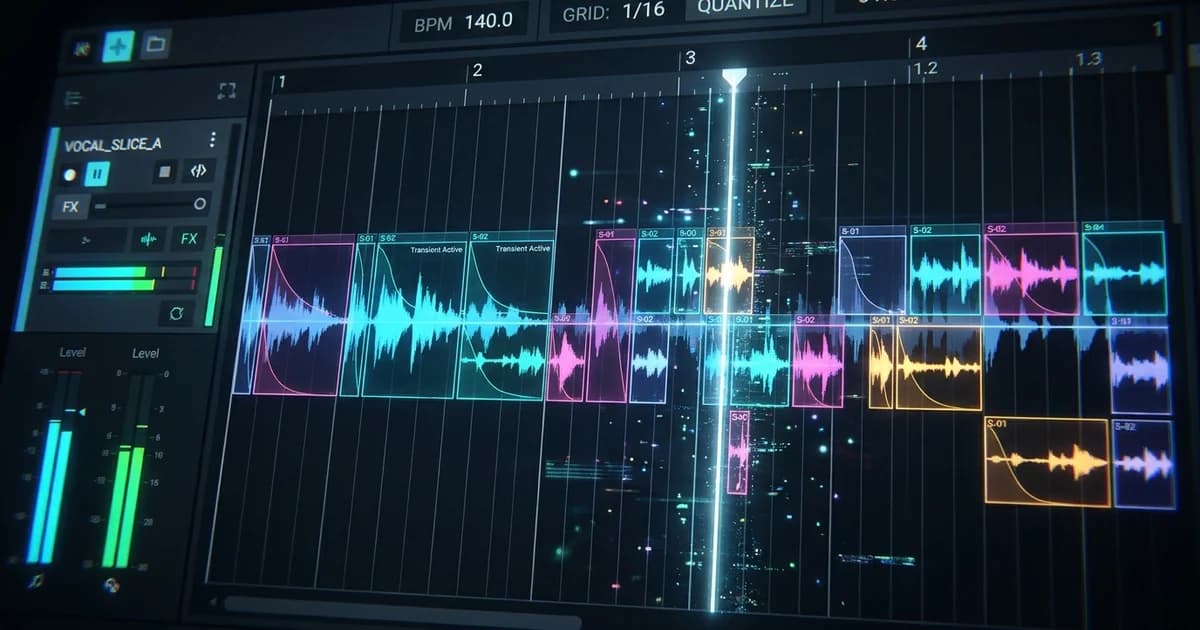
Vocal chops are short pieces of a recorded voice rearranged into a musical pattern. To make them, choose a clear phrase, cut a few usable syllables, map or arrange those slices in your DAW, and tune the sustained material to the song. Your own recording is a simple place to start.
You do not need a whole vocal performance or a large sample collection. A few contrasting sounds can make a hook if the rhythm and notes leave room for the rest of the arrangement.
Choose the source before choosing effects
Look for three useful ingredients:
- A sustained vowel for notes or longer textures.
- A clear consonant for a rhythmic attack.
- A short breath or unpitched sound for contrast.
A dry solo recording gives you more control than a phrase with long delay tails or accompaniment. If the source is a cleared full mix, vocal isolation may help, but separation residue becomes part of every slice you repeat.
Keep a copy of the source phrase. Once the pattern works, you can compare another vocal character without rebuilding the musical idea.
1. Keep a source copy and mark useful moments
Duplicate the recording and listen for a small selection of sounds with different attacks and lengths. Keep a recognizable lyric out of the pattern if you want it to function as an instrument rather than a repeated sentence.
Decide whether the original meaning matters. A chop placed out of context can create an unintended word or phrase. Listen to the pattern as language as well as rhythm.
2. Slice without clicks
Cut just before the attack you want to keep, and preserve enough of the tail for a natural release. Use short fades or an appropriate sampler envelope when a cut clicks. Do not remove so much of the beginning that the syllable loses its identity.
You can place slices directly on an audio timeline or load them into a sampler. On a timeline, the pattern is visible as separate clips. In a sampler, you can trigger slices from notes or pads. Choose the method you can edit confidently; neither is inherently more musical.
For a sustained vowel, compare a clean short envelope with a longer decay. For a percussive consonant, avoid a long tail that masks the next hit.
3. Find the original pitch before transposing
For a clearly pitched slice, identify its stable note with an instrument or pitch display. Trim away transitions that confuse the reading, then listen against the chord.
Do not assume every syllable in a phrase has the same pitch. A slice with a glide may not have one stable note at all. It can work as an effect, but you should not treat it like a perfectly tuned oscillator.
Transpose the useful sustained section to notes that fit the progression. Check whether your sampler links pitch and duration: a higher note may play faster in one mode and keep its length in another. After a large shift, listen for damaged consonants or a change in vowel character.
4. Write a small rhythmic idea
Start with a two-bar loop and one or two slices. Place a few attacks, leave a gap, and repeat or answer the first pattern in the second bar. This is a composition exercise, not a requirement to fill every subdivision.
An illustrative pattern could put a short syllable on beat one, answer it after beat two, and let a longer vowel finish the bar. Adjust it against your kick, snare, and lead rhythm. The best placement depends on where the song has space.
If the pattern feels mechanical, change velocity, note length, or a few placements intentionally. Randomizing every hit is not the same as writing a groove.
5. Add processing after the pattern works
Balance the dry pattern first. Then try filtering, distortion, reverb, or delay for a specific role. A wide effect may suit a transition but blur a busy chorus. A delay throw on the final chop can create movement without filling the entire loop.
If the song has a lead vocal, check both together. Chops with strong consonants or recognizable words can compete with the lyric even when their level seems low.
See how to mix vocals for level, tone, dynamics, and space decisions that also apply to vocal fragments.
Keep the pattern connected to the song
Mute the chops briefly, then bring them back. Do they add a hook, answer the singer, or carry the rhythm through a transition? Keep the slices and variations that serve that role, and save the unprocessed phrase for future edits.