

Male to Female Vocal Transformation: How to Pitch Shift and Re-Voice Across Genders
Learn how to transform male vocals into natural female singing voices. Master octave transposition, formant alignment, and Sweetspot register matching.
By Vocalist.ai Editorial Team · August 6, 2026 · 5 min read
Converting a male vocal take into a female singing voice is one of the most common and creatively exciting applications of AI vocal transformation. Male songwriters frequently write songs intended for female artists, and producers often want to audition how a chorus sounds sung by an airy soprano or soulful female alto.
However, transforming across genders is also one of the most acoustically demanding vocal workflows. If you simply take a male vocal recording and apply an AI female voice model without adjusting pitch or register, the output often sounds unnatural, muffled, or strained.
Why? Because male and female vocal tracts have fundamentally different physiological lengths, resonant formant structures, and pitch ranges.
Here is how to bridge that acoustic gap and turn male vocal recordings into stunning, authentic female lead vocals.
The acoustic gap: Why cross-gender transformation needs transposition
There are three physiological differences between male and female voices:
- Fundamental Pitch (F0): On average, adult male singing voices sit roughly one octave lower than adult female singing voices (e.g., C3 vs. C4).
- Vocal Tract Length & Formants: Female vocal tracts are typically 15% to 20% shorter than male vocal tracts, resulting in naturally higher resonant formant frequencies (F1, F2, F3).
- Harmonic Spacing: Because female fundamental frequencies are higher, their harmonic overtones are spaced further apart in the frequency spectrum.
If a male baritone sings a melody at A2 and feeds it directly into a female soprano model without pitch transposition, the model is forced to extrapolate how a soprano would sound singing in a sub-bass chest register she never physically uses. The resulting audio often sounds strained, muddy, or robotic.
The Core Rule: High-quality cross-gender vocal transformation requires pitch transposition. You must shift the input performance into the female singer's natural physiological register.
4 steps to a natural male-to-female conversion
Follow this step-by-step tutorial to achieve natural, release-ready results:
Step 1: Upload a clean, dry guide vocal
Start with a solo male vocal recording free of reverb, delay, autotune artifacts, or background track bleed. Any background bleed will be shifted along with the voice, creating phase distortion. Review our input audio preparation guide for audio examples of clean input takes.
Step 2: Select an appropriate female voice model
Open the Artist Browser and choose a female model that fits the genre and emotional tone of your song:
- For intimate, breathy indie/pop: choose an airy, lighter female voice.
- For powerful, belting hooks: choose a soulful pop/R&B model with strong chest-voice training.

Vocalist's Artist Browser for comparing available singer models.
Step 3: Use the Sweetspot Analyzer for pitch alignment
In Vocalist, the Sweetspot Analyzer displays two visual range bars:
- The dynamic color bar shows your male input vocal's pitch distribution.
- The reference bar shows the female model's natural vocal sweet spot.
Adjust the input pitch shift control until your input bar overlaps with the model's range and turns green:
- Typical shift: Usually +5 to +7 semitones for baritone-to-alto conversions, or +12 semitones (one full octave) for baritone-to-soprano conversions.
Here is a controlled ALIICIA-model comparison using the same source phrase. At zero semitones the phrase sits outside the intended range; the second render shifts that input up one octave. The finished acoustic mix shows the selected result in context.
The unshifted range-mismatch render.
The same phrase shifted up one octave before conversion.
The chosen vocal result heard in its acoustic production context.
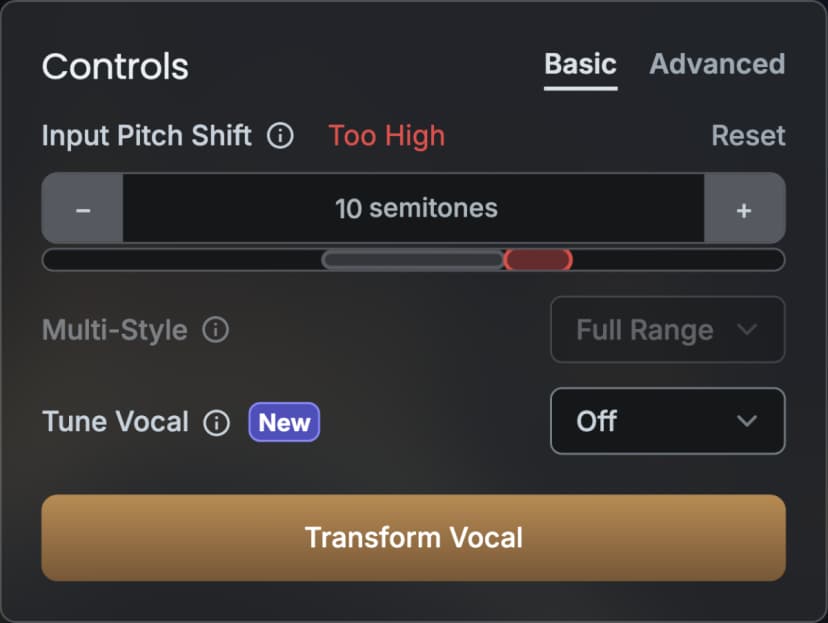
Sweetspot Analyzer showing a poor match between the input and model range.
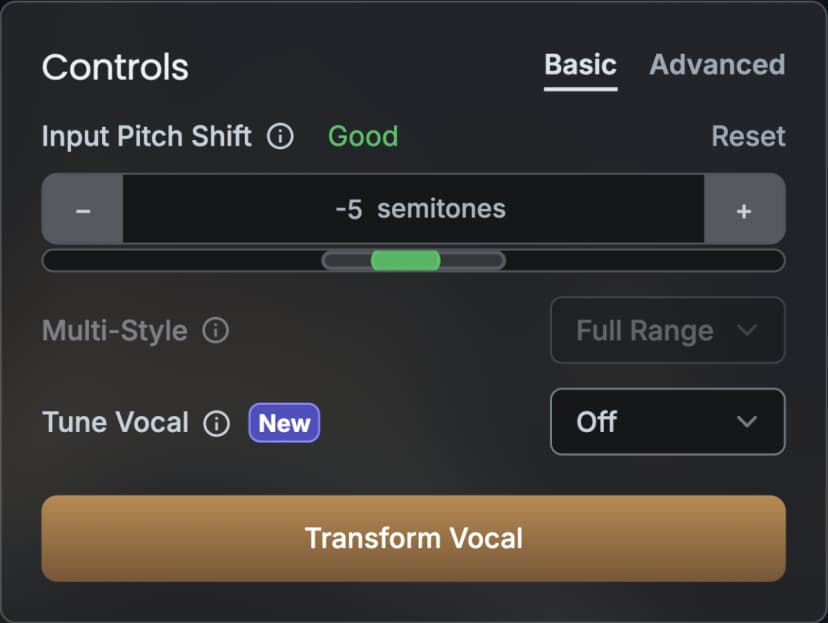
Sweetspot Analyzer showing improved overlap after adjustment.
Step 4: Sing with lighter consonant weight
When tracking a guide for a lighter vocal style, experiment with gentler consonant attacks, brighter vowel placement, and clean diction. The model will retain much of your phrasing while applying the target singer's learned timbre.
Female to male conversion: The reverse workflow
The exact same acoustic principles apply in reverse when converting female vocals to male singer models:
- Shift the input pitch down by -5 to -12 semitones.
- Use the Sweetspot Analyzer to ensure the shifted performance does not drop into sub-bass rumble where pitch tracking becomes sluggish.
- Apply high-pass filtering in your DAW around 80 Hz to keep the low-end clear of rumble.
Read our companion guide on vocal formants to understand how resonant filters shape vocal gender perception.
Conclusion
Cross-gender vocal transformation is a useful production tool for songwriters and producers. By shifting the input into the model's trained range and checking pitch overlap with the Sweetspot Analyzer, you give the transformation a better chance of sounding clear and expressive.