

Make Your Verse Hit Harder with Original Rap Ad Libs
Learn what rap ad libs do, plan original responses around your lead, record contrasting takes, and give each phrase the space and vocal character it needs.
By Vocalist.ai Editorial Team · October 30, 2026 · 4 min read
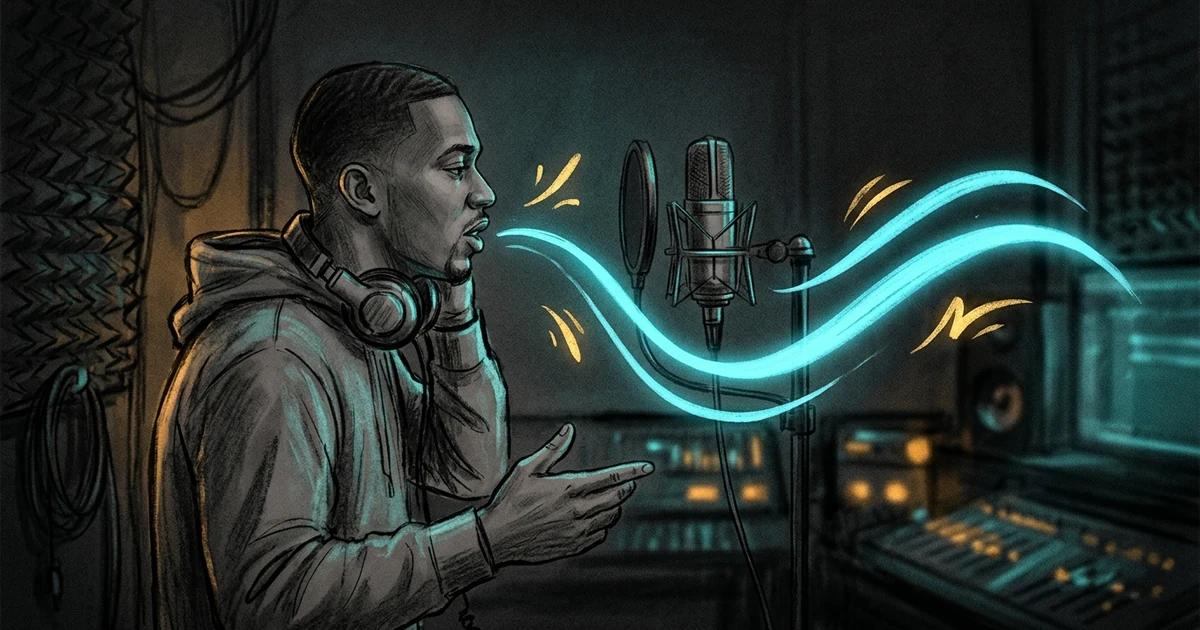
Rap ad libs are short vocal responses, tags, and accents that add emphasis and personality around the main performance. A whispered answer, a shouted word, a laugh, or a recurring phrase can become the detail you remember after the verse ends.
The trick isn't filling every silence. It's choosing the moments where a second vocal makes the lead more effective. Start with the words and rhythm of your own verse, then give each response a job.
What makes an ad-lib different from a double?
A word double reinforces something the lead already says, usually near the same moment. An ad-lib can answer it, comment on it, interrupt it deliberately, or create a recognizable tag.
| Part | Musical job | Recording decision |
|---|---|---|
| Word double | Reinforce an important lyric | Perform the selected words again |
| Short answer | Add a reaction after a line | Leave room for the response to finish |
| Accent or sound | Mark a rhythmic moment | Match its attack and length to the beat |
| Recurring tag | Create a recognizable motif | Repeat selectively, not automatically |
Published discussions such as Billboard's ad-lib examples show how a short sound can become part of an artist's identity. The useful lesson is function: emphasis, contrast, and recognition. You can build those functions around your own wording and delivery.
Mark the gaps before recording
Loop a short section with the lead and beat playing. Mark three kinds of space: a clear gap after a line, a word that deserves reinforcement, and a moment that should stay empty.
Here is an illustrative four-line plan, not an audio transcription:
| Lead phrase | Response idea | Reason |
|---|---|---|
| "I kept the light on" | Quiet "still here" after the line | Adds another perspective |
| "When the whole block slept" | No response | Leaves the image clear |
| "Now the door swings open" | Short "open" accent | Reinforces the turn |
| "And I walk right in" | One sustained reaction after "in" | Carries energy into the next section |
If the response has to be unnaturally rushed to fit, shorten it or move it. Don't sacrifice a strong lead line to keep an extra sound.
Record contrasting options, not endless copies
Record a restrained pass and a more animated one on separate tracks. Try changing distance, register, length, or attitude while keeping a usable, unclipped recording. A short answer may work better with a different energy from the lead than with more volume. You can perform the responses yourself and use Transform to give them contrasting vocal characters, without needing another performer for every part.
Keep the performances separate from the beat and from one another. Export from a shared bar boundary so silence before each response preserves its position. The rap transformation guide explains preparing dry solo takes and listening for articulation.
Audition character without losing the response's purpose
In Vocalist, use the separately recorded response as the input and audition a model on that phrase. Your performance supplies the timing and wording; choose a character that makes the answer feel distinct without stealing the verse.
Compare three things when the output returns to the DAW:
- The first consonant: does the response enter clearly, or collide with the lead's last word?
- The word ending: does a held vowel or breath run into the next line?
- The emotional role: does the new voice sound like an answer, an emphasis, or an unrelated interruption?
Changing the voice won't create a better gap in the arrangement. Move, trim, or remove a response when the musical problem is placement.
Mix around the main lyric
Bring responses up from silence with the full beat playing. Start with a level that lets you notice their contribution without needing to follow two equally loud lines.
Use panning to create separation where it helps, but check mono. A short filtered response or selected delay throw can add contrast; applying a long tail to every answer usually consumes the gaps you worked to preserve.
If a word feels smeared, compare timing and the original takes before adding brightness. Our doubling guide covers alignment when reinforcement rather than an answer is the goal.
Keep the responses that change the verse
Mute the ad-lib tracks and play the section. Then restore them. The best additions make a phrase land, reveal personality, or build a transition. If they only make the arrangement busier, simplify.
Save the dry responses and the chosen outputs separately so you can change the cast or the mix later. For the broader supporting arrangement, continue with building backing vocals.