

AI Vocal Enhancers: What They Actually Do and How to Process Vocals Cleanly
Demystify AI vocal enhancers. Discover how neural processing handles pitch correction, de-reverberation, noise reduction, and vocal timbre transformation.
By Vocalist.ai Editorial Team · August 20, 2026 · 4 min read
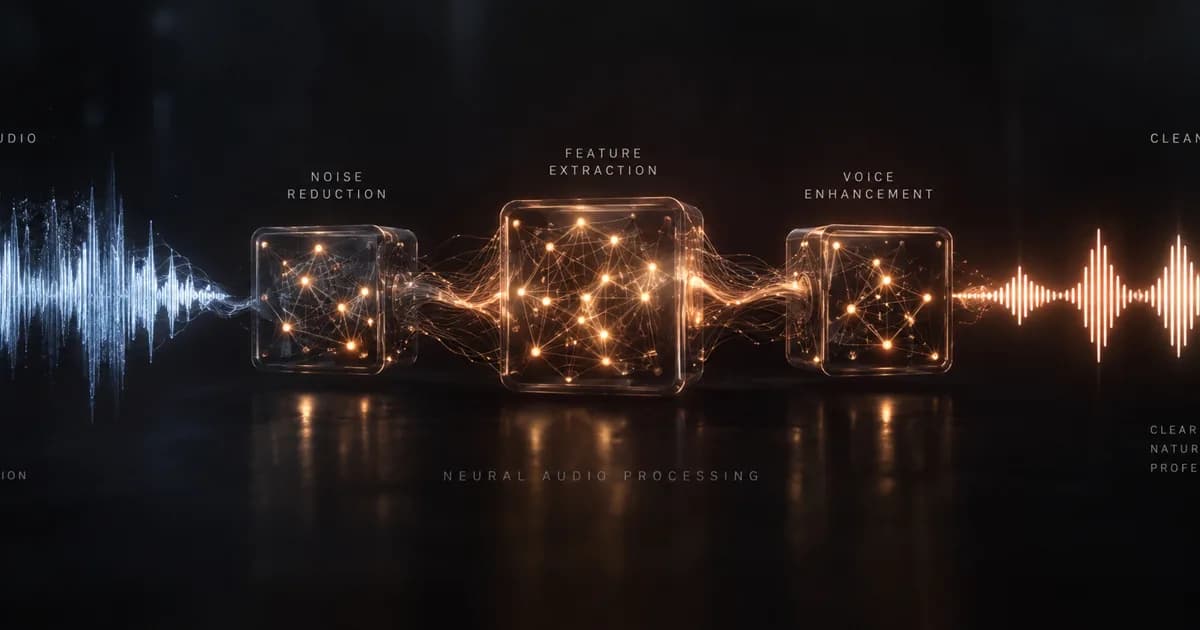
The phrase "AI vocal enhancer" has become one of the most common search terms in modern music production. Software advertisements frequently promise that with a single click, an AI tool will magically transform a rough microphone recording into a pristine, Grammy-winning lead vocal.
For music producers, audio engineers, and recording artists, these marketing claims can be frustratingly vague. What does an "enhancer" actually do? Is it an EQ curve? A smart compressor? A pitch correction plugin? A stem splitter? Or something else entirely?
To get the best possible sound from modern vocal technology, you need to look past the marketing hype and understand the specific audio engineering functions that neural algorithms actually perform.
Here is a breakdown of what AI vocal processing does under the hood and how to build a clean, transparent vocal signal chain.
Demystifying the "Enhancer": 4 distinct audio functions
When a modern audio platform claims to "enhance" vocals, it is almost always combining one or more of these four distinct deep-learning technologies:
1. Neural noise suppression and de-reverberation
Traditional noise reduction used spectral subtraction, which often left watery "musical noise" artifacts in the background. Modern AI denoisers use convolutional neural networks trained to identify human speech and singing patterns.
Different tools target different problems: denoisers reduce steady background noise, while de-reverberation tools reduce room reflections. Vocalist's Stem Splitter De-Reverb mode focuses on separating a vocal and reducing its existing reverb in a single pass. Read our guide on how to remove reverb from vocals for deeper analysis.
2. Intelligent pitch correction and stabilization
Modern neural pitch analysis estimates the notes in a vocal performance, while key, scale, and correction-strength controls determine how firmly those notes are pulled toward their targets. Gentler settings can retain more of the original vibrato and slides; stronger settings create a more obvious locked-note effect. Review our vocal pitch correction guide to understand the balance between natural correction and hard-tuned effects.
3. Dynamic leveling and transient control
Traditional compressors apply a fixed gain-reduction curve based on an overall volume threshold. AI dynamic enhancers continuously track vocal consonant attacks (like "p", "t", and "s") versus open vowel bodies, leveling out uneven vocal dynamics without pumping or introducing harsh distortion.
4. Singing voice conversion (SVC) / Timbre transformation
This is the most advanced tier of AI vocal processing. Rather than merely cleaning up the existing recording, singing voice conversion transforms the vocal formants and timbre of the performance into another singer's voice entirely while preserving the underlying lyrics, pitch contour, and rhythm. Read our comprehensive guide on singing voice conversion to explore the mechanics of timbre mapping.
The limits of AI enhancement: What algorithms cannot fix
No neural network - no matter how advanced - can overcome the fundamental laws of digital acoustics:
| Audio Defect | Can AI "Enhance" It? | Why or Why Not? |
|---|---|---|
| Severe Digital Clipping | Rarely | When an audio interface converters clip, the waveform is squared off and harmonic information is permanently lost. |
| Heavy Track Bleed / Overlapping Voices | Partially | While stem splitters can isolate lead vocals, heavy background shouting or drums leaking into the mic can leave high-frequency phase flanging. |
| Unemotional / Hesitant Delivery | No | AI models transform vocal timbre, but they preserve the incoming energy, timing, and dynamic intention of the performer. |
| Muffled Diction / Swallowed Consonants | No | If consonants were never articulated into the microphone, an algorithm cannot invent missing linguistic clarity. |
Review our input vocal preparation guide to hear audio examples of what makes ideal input audio.
Building a clean modern vocal signal chain
To get professional vocal results without over-processing, apply tools in their logical acoustic order:
- Clean capture: Record with proper microphone technique, a pop filter, and 12 dB of digital headroom. Read our guide on how to record vocals at home.
- Restoration & De-Reverb: Remove room echo and background noise before applying compression or EQ.
- Pitch stabilization: Correct fundamental pitch issues on dry, clean audio.
- Voice transformation (optional): Convert the performance to an alternative singer model if desired.
- Creative mixing: Add tasteful compression, EQ, saturation, and stereo time-based effects (reverbs and delays) last.
Our AI vocal repair guide explains how cleanup choices can prevent artifacts from becoming more noticeable later in production.
Summary
An "AI vocal enhancer" is not magic - it is a collection of powerful neural tools designed to clean up acoustic defects, stabilize pitch, and transform vocal timbres.
When you understand how these algorithms function and feed them clean, expressive guide recordings, you can achieve studio-grade vocal productions that sound natural, dynamic, and commercial.